
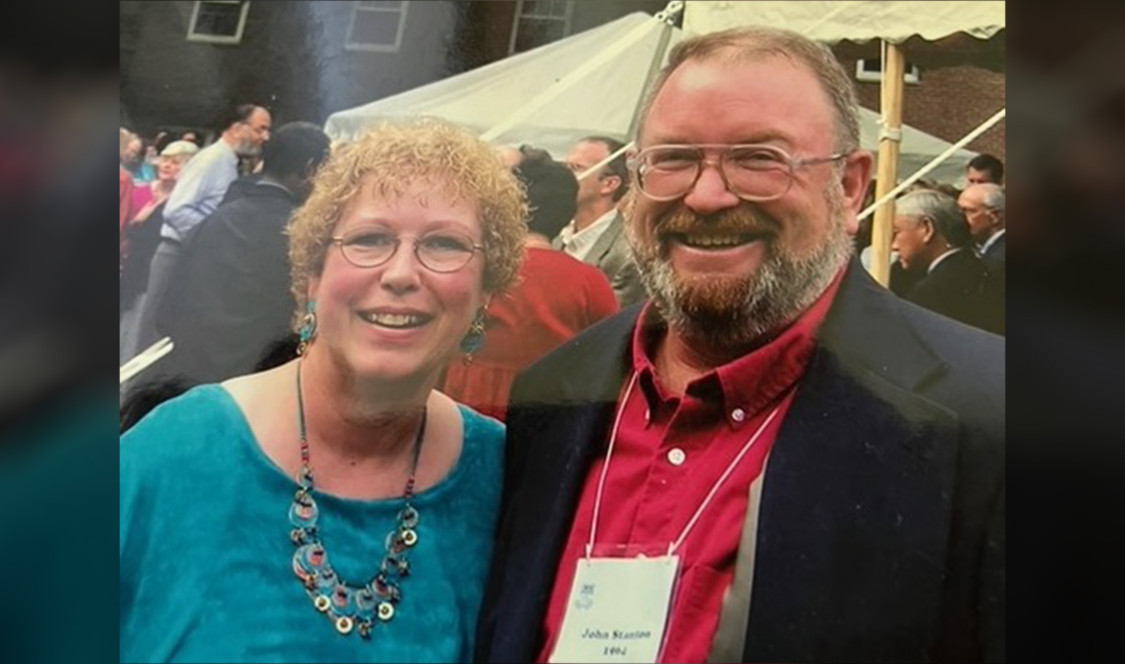
The life paths that John Stanton ‘68 followed brought him into contact with a wide range of military assignments including a tour of Vietnam and unusual challenges both in the Army and civilian life. His range of military duties included searching soldiers’ locations using manual card files, an introduction to the Army’s first attempts at automation and records conversion and as Officer-in-Charge of a fully operational, overseas Army Post Office. On the civilian side he found himself working in insurance sales and service, as an employee benefits consultant, a Chamber of Commerce Executive, and a newspaper sales representative. He has lived far and wide including Indianapolis, Monterey, Detroit, San Diego, Honolulu (on a boat!), Pine (AZ) and Klamath Falls (OR). His military service follows a path of committed service to our country, following in the footsteps of his father who was a PT Boat Officer and his stepfather, an Infantry officer in Europe during WWII. He describes his military and civilian careers as boring and dull...they were anything but. Read on...
When John Stanton ‘68 started at CMC in 1964, he thought a football back injury would keep him out of military service. It did not and in December 1966, he received notice to report for an induction physical that he passed. Wishing to complete college, he applied for admission to CMC’s 2-year ROTC program. He was told he would have to pass basic infantry training at Ft. Benning, Georgia to be considered. He was off to Georgia that summer and stayed in the same wooden barracks where his stepfather had been billeted in 1943. He attended and completed the advanced ROTC training at Ft. Lewis in 1968. After completing the necessary requirements, he finished as the ROTC Cadet Training Officer in his senior year. He put new cadets through a realistic field training exercise by making them crawl through the mud south of the football field while shooting at them with toy machine guns and exploding firecrackers around them. John graduated as a Distinguished Military Graduate (DMG) and chose Adjutant General Corps as his branch. Throughout his ROTC training, John learned an important lesson about how to establish working relationships with other cadets coming from different levels of society and backgrounds.
Returning to Claremont, John attended Claremont Graduate School for a year while managing the Gourmet Liquor Store on Mountain Boulevard in his spare time. He married Betsy Barrett, Pitzer ‘68, and was commissioned as a Second Lieutenant in June of 1969. Hired by Aetna, they moved to Avon Ct to attend a 16-week employee benefits school. Then it was off to Ft. Benjamin Harrison, Indiana for Basic AG training and subsequent assignment to the 6th Army Postal Locator Section at Ft. Ord, California.
Public feelings about the Vietnam war had begun to shift dramatically in the US in 1969. Kent State occurred; vets were returning from Vietnam by the thousands; and Nixon sent American troops into Cambodia causing a major uproar. And with the unpopularity of the draft, the Volunteer Army (VOLAR) concept became the new norm with soldiers relieved of KP when civilians were hired to cook and wash. “The times they were a-changing!”
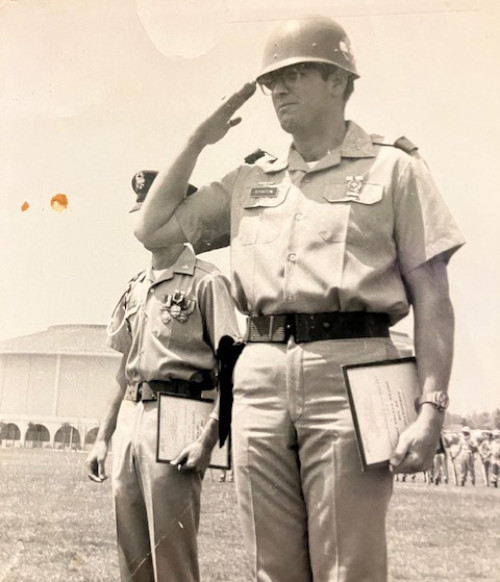
John’s position at Ft. Ord was as a “Postal Locator.” He and 12 other soldiers were responsible for maintaining tens of thousands of manual card files providing the location of soldiers within the 6th Army. They would receive requests for address forwarding and would walk from filing cabinet to filing cabinet manually consulting the card files to provide the latest information. Computer automation was thrust upon them in 1970, and John’s unit began the arduous task of records conversion with little or no advanced computer training. John and Betsy lived off Post in Monterey enjoying the area and often playing mixed doubles tennis.
Then in July 1971, John received orders transferring him to Vietnam. He was astonished to find himself at 3 AM packed into an American Airlines jet flying across the Pacific first to Honolulu and then on to Long Bien in Vietnam. He was advised by a returning vet to “be sure to pack his tennis racquet,” which he did, enduring the laughter of all those seated around him. John did play some tennis in Vietnam as the war had started to take a dramatic downturn from combat engagement to stand-down and institution of the Vietnamization of South Vietnamese forces.
Another Ft. Ord transfer got John assigned as the Postal Officer for the 3d Brigade of the 1st Cavalry Division Headquarters located in Bien Hoa, only 3 miles away. He was a 1st Lieutenant, Postal Officer and responsible for APO 96490, handling mail for 8 battalions. His unit was to be the last combat unit to leave Vietnam. John was also assigned as the “LBSJ” (Little, Bitty, Shixxy Jobs) Officer and was able to attend the Brigade briefings on a semi-regular basis. He noted that little was happening. The American offensive was over, and it became clear that the North Vietnamese Army was poised and getting ready to send tanks into Saigon.
John was able to spend two weeks of R&R in Hawaii with his wife and was visited by John’s parents who flew over for the last three days of his time. He returned to Vietnam and endured the tedium by studying enemy weapons that “found their way” to the base. His unit received thousands of packages of cakes and cookies at Christmas time mostly for soldiers who had already returned to the US. “Bless the American people!” exclaims John. He is proud of the fact that he was able to get all his men over to Long Bien to see the last Bob Hope show held in December 1971. They watched Bob and Joey Heatherton perform in front of thousands of soldiers.
The American Army was standing down. Soldiers’ attitudes had changed and there was no desire to risk one’s life to “die for a tie.” There were six attempted “fragging's” during this period. The war was winding down and John received orders to return to the US and was released from active duty upon return to the States. It was a was a confusing and mixed-up time as the war ground to its gradual and dramatic end three years later the roof of the American Embassy.
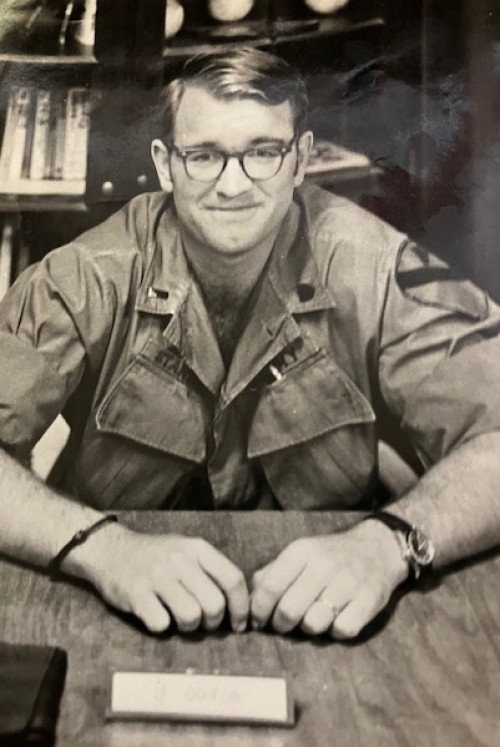
Then followed a return to insurance work as an employee benefits consultant with Aetna in Detroit and Indianapolis. But the Reserves reached out and claimed him for duty at Ft. Benjamin Harrison, Indianapolis where he participated in field exercises at Camp Attebury in Southern Indiana. John found himself responsible for 120 soldiers including four pregnant females. The unit took to the woods on the hottest day of the year at 3 AM. An aggressor force attacked them regularly, but John organized a quick reaction force consisting of former Vietnam combat vets who repulsed a night ambush scaring the hell out of the aggressors by screaming and yelling and firing off clips of blank ammunition. This assignment persuaded John that he was “getting too old for this shxx” and he hung up his Army uniform for good.
Then followed a series of positions with Aetna Health and Life for seven years in the Midwest. An offer from Johnson & Higgins in San Diego tore him away from the Midwest, where he was lucky enough to form many close business relationships with Buck Knives and others. During this time, he and his second wife, Debbie, lived on a sailboat. They subsequently moved to Hawaii for three years and continued to enjoy boat life working for J&H. John’s love of boats began at age 8. He owned various sailboats in Newport Beach, but when Debbie spotted a 40-foot classic Newporter Ketch, life changed. With a live aboard slip in Coronado, they sold all their household stuff and moved aboard. This arrangement lasted for 2 years in Coronado, and they had the boat sailed to the new job in Hawaii. After living aboard for a year, a broken ankle forced a move to shore.
After returning to California in 1988, they again purchased smaller sailboats to moor at the Coronado Yacht Club, and, as you can guess, another boat became their abode. This time it was a 41-foot diesel trawler that even had a shower onboard! They sold all their household goods again, moved aboard and remained on the water until moving to Arizona.
Once back in the US, John took a position with Health Net, an HMO in San Diego from 1989 to 1994 and then from 1995 to 2000 he worked for Kaiser Permanente as a Senior Account Executive. Ultimately, John semi-retired to Pine, Arizona and lived in a remote valley that had an actual pine forest where he changed gears and served as the Rim County Regional Chamber of Commerce Executive Director and for the Payson Round Up Newspaper. John fully retired in 2020 and moved to Klamath Falls, Oregon. John has two daughters from his marriage to Betsy: Samantha and Katherine.
Most of John’s life lessons learned were learned “the hard way” and he lists them as follows:
- Alway arrive early
- Prepare, prepare, prepare
- Always address the worst problem first
- Problems do not go away...solve them
- Treat people with respect, you never know when you will need their help
- Saying please and thank you sets you apart from the competition
- Empathy for others leads to “yes!”
- Keep focused on the prize
- Do not major in minor problems
- Shine your shoes!