
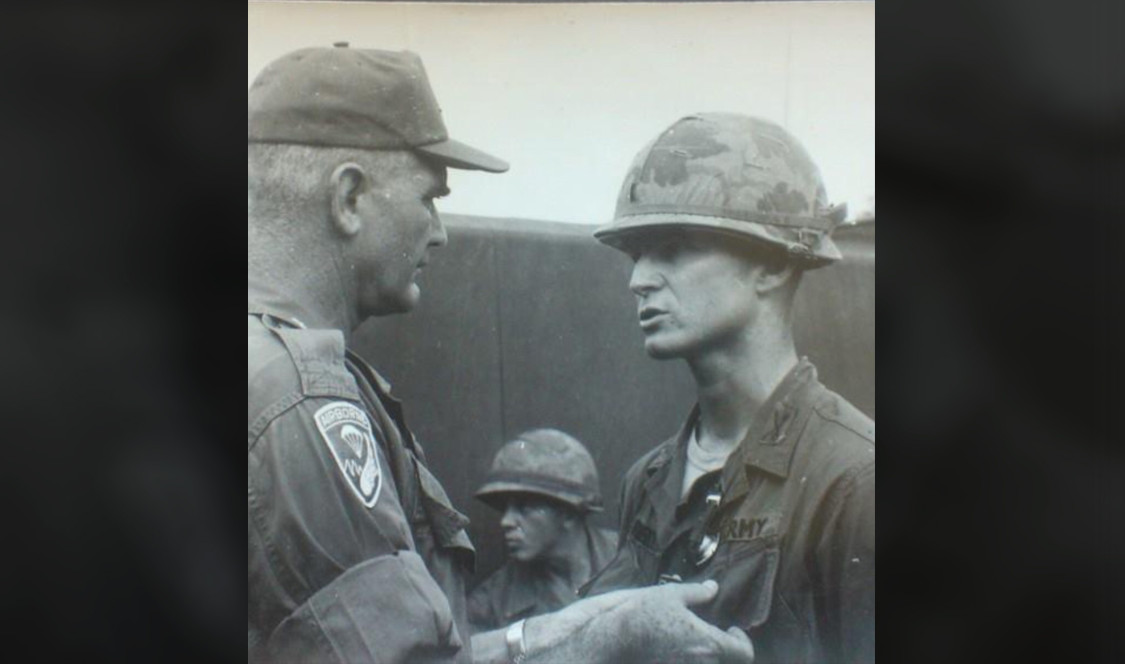
Before transferring to CMC in his Sophomore year in 1962, Gil Ferrey ‘64 and a buddy spent four-months in an East German prison.
Seven months after the construction began on the Berlin Wall, Gil Ferrey ‘64 and his buddy, Vic Pankey, took a semester off to study in Europe and to travel. Curious about the recent construction of the Berlin Wall, they drove into East Berlin through Checkpoint Charley. The two attempted to help a young female student escape to the West by packing her in the trunk of their bright red VW Beetle (she fit – just barely). They were caught by East German Border Guards, arrested, tried in a Napoleonic legal system, convicted, and sentenced to two years' confinement in an East Berlin prison.
The pair was initially held in solitary confinement for interrogation and prior to their trial and the subsequent “appeal process,” which was a total sham. After a month of solitary confinement in 11 cubic meter cells, they were transferred to Hohenschoenhausen Gefangnis, a prison used only for interrogation and special prisoners. They were placed with two other prisoners, Bernie Collett and Henri Pierott, in a larger single cell with two sets of bunk beds.
Soon after their confinement, a prison official with an interpreter came and told them they would be treated the same as if they were in an American prison, such as Sing Sing! When asked if they had any questions, and with mouths agape, the door to the cell slammed shut. Drawing on personal courage and chutzpah, Gil somewhat precociously knocked on the door, and when opened with a “Wass?” or “What do you want?” response, Gil gave the official a list of requests, saying this is what an American prisoner would expect to be provided at Sing Sing. His request included books, writing paper, a radio, four chairs and a worktable and hot tea with lemon and sugar every night before lights out at 10 PM. The official responded asking, “What do you think this is, a hotel?” Then Gil simply responded, “You just said we would be treated the same as if we were in Sing Sing.” The official then realized he had put his foot in his mouth, and they received everything requested. This was the first indication that they would be released to have no basis to badmouth the Stasi and the East German Government.
Shortly before Christmas (1961), a British Member of Parliament came to visit Bernie in their four-man group and he was released. Gil asked his attorney, “How is it that you call yourself the German Democratic Republic and you release one prisoner with the same sentence that we received, and yet we remain incarcerated? That’s not fair!” Gil was hopeful that he and Vic might receive similar treatment, playing on the extreme paranoia that existed within the East German dictatorship. He also mentioned, with somewhat tongue in cheek, that if he and Vic did not return to continue their education in the U.S. for the spring semester in 1962, they might be disallowed from continuing their education totally. Not finding students to replace them could mean a loss of income for their colleges and would jeopardize their future. The ploy worked and the pair was released on January 15, 1972, and returned to re-commence their studies. The General Secretary of the Communist Party of East Germany, Walter Ulrich, claimed that he was granting them clemency.
Gil had originally applied and been accepted to the freshman class at CMC but had opted to go to CAL Berkeley. He thought engineering would be the best major for him. He found he loved CAL but did not enjoy engineering, so transferring to CMC to enjoy smaller classes and study Business Economics was his next step. Many of his family members had also attended Claremont Colleges. Gil’s life at CMC after his East German ordeal improved dramatically. He participated in the ski club, intermural sports, sang in the choir, participated in drama at Scripps, and became the Executive Officer of the Army ROTC Battalion in his senior year. As a senior, he also participated in an Army-sponsored program learning to fly fixed wing aircraft at Cable Airport. This obligated him to an additional year’s commitment after going on active duty, but he felt it was worth it to get his pilot license.
He graduated with his class in June 1964 with a branch assignment as an Armor Officer. He attended the Armor Officer Basic Course at Fort Knox, Kentucky, where he placed first in his class. While awaiting an opening to attend helicopter flight school, Gil was assigned to A troop, 4/12th Cavalry Squadron, Fifth Infantry Division at Fort Carson, Colorado, where he served as a platoon leader. One night, while on an FTX (field training exercise), he and another officer crawled through damp weeds to capture the commander of the opposing force, which they did, much to the commander’s chagrin.
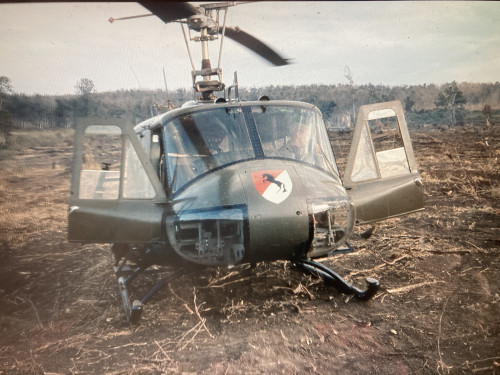
Helicopter pilots were being trained as fast as possible as the Vietnam War was heating up and Gil finally got his orders, sending him to Camp Wolters in Mineral Wells, TX. There, he learned to fly Hiller OH-23 Raven helicopter (commonly referred to as “the Hiller Killer.”) Upon completion of primary training, he was sent for advanced training to Fort Rucker, Alabama, where he flew Bell UH-1, “Hueys,” and new TH-13T Bells for instrument training. Gil and his stick mate completed their training and earned their FAA instrument ratings.
Upon receiving his wings in December 1965, Gil was the only officer to receive orders to Korea from his flight class. In Korea, he served as a pilot and as the S2 Intelligence Officer of the 7th Aviation Battalion. His job consisted of flying the 7th Division Brigade Commanders along the DMZ while overseeing FTX’s, as well as attending Divisional intelligence briefings. While in Korea, he met classmate Larry Berger ’64 totally by chance.
In April 1966, all members of the 7th Aviation Battalion with an aviation MOS (Military Occupational Specialty) were sent on short notice back to the states, where they could choose to join either the 4th Infantry Division at Ft. Lewis, WA, or the 11th Armored Cavalry Regiment at Ft. Meade, MD. Gil opted for the “Blackhorse Regiment” where he assisted in getting the unit ready for deployment to Vietnam by ferrying helicopters from as far away as Fort Hood, Texas, going to gunnery school at Fort Benning, GA, and participating in two FTX’s to assure the Pentagon that the 11th ACR was ready to be deployed for combat. As a bachelor, Gil volunteered to join the Regiment’s Advanced Party to hopefully get some in-country flight experience during the monsoon season for both area orientation as well as tactics before the main body of the 11th ACR arrived by ship. He and others in the Advanced Party flew by C-141 to Vietnam where the experience he gained may have saved his life and that of others.
After building a staging area near Long Bien, he and five other pilots were assigned temporarily to two experienced Assault Helicopter Companies (A Co/501st - later the 71st, and the 118th Air Mobile (Lt.) in Bien Hoa, where he flew both UH-1D slicks and UH-1C gunships. The slick helicopters were armed with 2 M60 machine guns, operated by the crew chief and a gunner, whereas the gunships had a combination of grenade launchers, rockets, and up to six machine guns, four controlled by the pilot.
Upon its arrival by sea, Gil rejoined his unit and flew the Regimental Commander, Col. William W. Cobb, as a member of the Regimental Aviation Section as well as gunships in the Air Cavalry Troop. After establishing a Base Camp just a few kilometers south of Xuan Loc, the Regiment commenced search and destroy operations within the III Corps area. Ultimately, he flew the Commander of the Regiment’s First Squadron, Lt. Col. Martin Howell.
The First Squadron was a battalion-size unit, part of the regimental testbed in Vietnam, while representing the Armor branch of the Army. It was sent to Vietnam to see if it could function with heavy tanks, armored personnel carriers, self-propelled 155 mm howitzers and infantry in a rice patty and heavy jungle terrain, especially during the monsoon season. The Squadron performed extraordinarily well in the environment, returning to its base camp only when heavy maintenance was needed.
Gil flew 900 hours of combat time, 700 of which were directly over the troops of the 11th ACR’s “First of the Blackhorse,” directing the troops on the ground. There was no GPS at the time and the forward observers were unable to call in supporting artillery fire accurately. So, from Gil’s helicopter, he, and his commander called in 21,000 155 artillery rounds supporting the advance of troops on the ground. This tactic proved to be a remarkably effective solution to keep our troops safe and properly oriented.
On one significant mission, the 11th Armored Cav Regiment’s First Squadron acted as “the hammer” as it moved northward toward the Cambodian border, where the 173rd Airborne Brigade, “the anvil,” had just conducted the only airborne operation of the Vietnam War (Junction City 1) just the day before. The purpose of the operation was to find and destroy COSVN, the Communist Army’s Headquarters in the jungle near the Cambodian border.
Gil was fortunate that he was never wounded, nor was any aircraft that he flew ever shot down. His helicopter did receive one round through the bubble shortly before coming home in August 1967, missing his passenger’s foot by 6 inches!
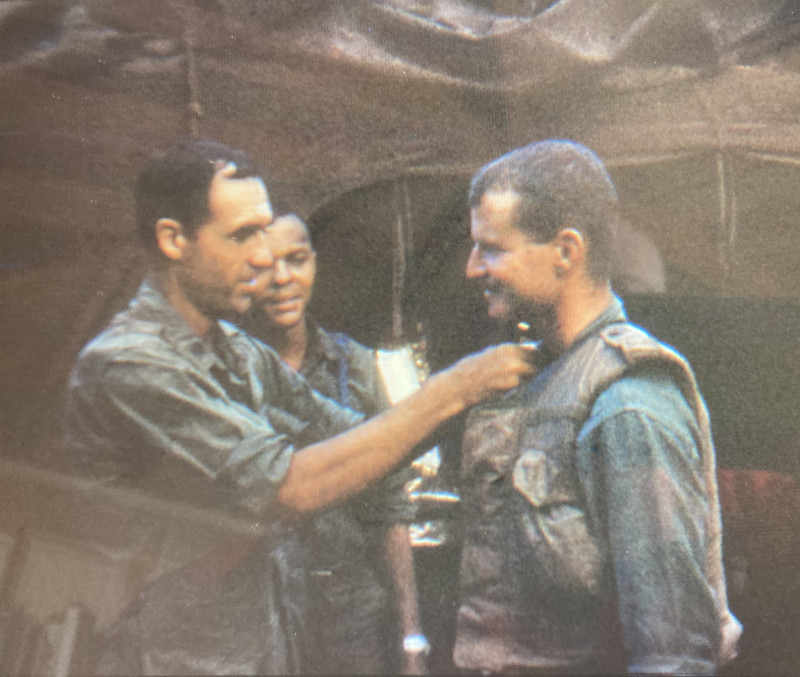
Shortly after re-joining the 11th ACR, General Westmoreland, with his entourage arrived at his base camp, and Gil became the first member of the regiment honored to receive his second Air Medal awarded by the general.
Upon separation from the Army following his three-year stint, Gil returned home via Australia on Circuitous Routing Orders. He interviewed several companies and chose to accept an offer from United Airlines. After going through flight training as a flight engineer, he was assigned to La Guardia and flew out of the New York area for a year flying Boeing 727s. When compared with his flying helicopters, however, he was unenthusiastic about the work and resigned from United.
He worked for a year in the Bank of California’s Investment Department, but was laid off in a ‘last in, first off’ reduction in force. He then joined Water’s Helicopter Company at SFO, where he flew for KSFO doing traffic watch reports and transporting bank data for Wells Fargo. When those two contracts ended, he and the Bell Jet Ranger he was flying were sold to Astrocopters, Ltd. in Oakland, and he worked there for several years. He flew for a variety of purposes, but primarily did external lift work on construction sites. In the meantime, he met his future wife while skiing in Switzerland in 1971, and he and Charlotte were married in 1972. Having lost a few friends in accidents, he decided to switch careers and joined Grubb and Ellis Commercial Real Estate Development in San Francisco as an Industrial specialist, where he remained for 22 years, retiring in 1994.
At that point, he started acquiring and managing commercial real estate for himself and his family’s own account, in which he is still involved to this day.
Gil’s Life Lessons Learned are many:
- Always tell the truth unless you find yourself in a situation where the only way out is to tell white lies. (Imprisoned by lawbreakers – the DDR)
- Remember who you are and what you represent.
- Do your best to represent your client while always placing their needs before your own.
- Enjoy your life and your family, and constantly keep your eyes open while observing life and learning from it.