

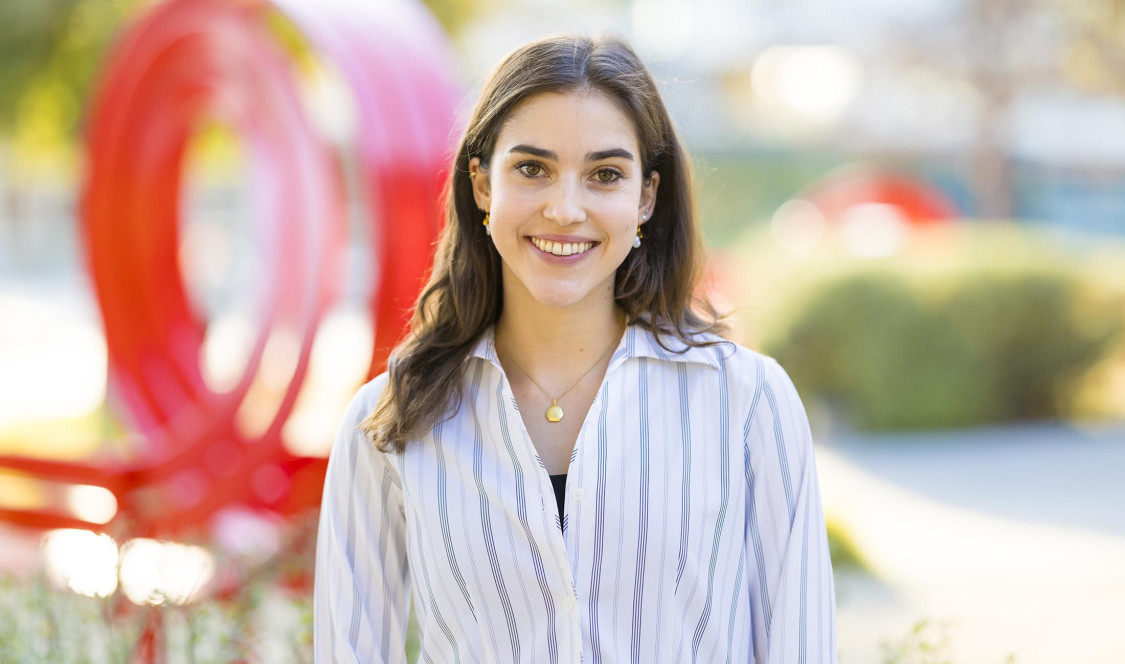
For Celine Bernhardt-Lanier ’26, responsible and effective leadership starts with relationships. It’s a lesson she’s learned throughout her educational journey at Claremont McKenna College—from roles as a Resident Assistant and Romero Success Coach to a human-centered design class and study-abroad experiences in Chile and New Zealand.
“I think before strategy, before implementation, it’s about asking, What excites us in this room right now?” said Bernhardt-Lanier, a French American Organizational Studies major from Barcelona, Spain.
Among her numerous campus leadership positions, her experience as an RA in Phillips Hall has meant the most.
“I don’t see being an RA as how many events I can plan each semester. I see it as shaping an atmosphere where students feel part of a community. I love helping shape an environment where we can all thrive in college.”
Finding the right environment for relationships was important to Bernhardt-Lanier from the start. She chose CMC for its tight-knit community and small, discussion-based classes.
“I wanted a place where people actually know each other,” she said. “And I love that my professors knew me, challenged me, and made themselves available.”
Another draw was the consortium model. “I loved the idea of being deeply rooted in one small college while having access to four other wonderful institutions. CMC felt expansive without being overwhelming. There’s intimacy, but also the freedom to explore other academic cultures and communities.”
Bernhardt-Lanier also appreciates the interdisciplinary nature of her major, where many of her classes are project-based and collaborative.
“In Organizational Studies, I have been able to understand how schools are designed, how they break, how they can evolve,” she said. “I loved taking classes in psychology, sociology, and education theory—thinking across disciplines.”
Volunteering with Jumpstart, a national early education organization, helped fuel Bernhardt-Lanier’s passion for education. She worked at a school in Upland, designing and implementing the kindergarten curriculum, and discovering the value of play and social-emotional learning.
She spent her junior year abroad working on group projects with Indigenous communities in two countries on opposite sides of the world.
In Chile, her independent study took her to a remote town where she interviewed learning guides and students at an alternative school. “It was like a creative design hub. I researched their model of facilitation to understand how students are treated as co-creators, rather than passive learners, and how creativity is embedded in this Chilean public-school model.”
In New Zealand, her “Strengthening Communities Through Social Innovation” course included projects with local partners, including a community garden initiative and learning about Māori perspectives on land, leadership, and community. “It helped me understand how much I care about applied learning and collaborating with others for a greater purpose.”
Back in Claremont, she discovered the Rick and Susan Sontag Center for Collaborative Creativity (a.k.a. “the Hive”), a design center for students, staff, and faculty across The Claremont Colleges. Bernhardt-Lanier practically took up residence there, participating in skill shares and makerspace workshops.
“The Hive gave me permission to create, design prototypes, build, and think in my own way,” she said. “This space was transformational for me at CMC and very empowering.”
Bernhardt-Lanier said her senior thesis on the Hive, “10 Years of the Hive: Successes, Challenges, and Lessons for Designing Creative Learning Hubs in Higher Education,” was a seminal part of her CMC experience.
“This project connected to a question I’ve been eagerly exploring since I transitioned from the French lycée to an alternative school in high school: How do we design learning environments where students feel curious, supported, and willing to experiment?”
Bernhardt-Lanier conducted interviews and focus groups with students, staff, and designers to examine how the Hive is designed and how students experience it.
“What stood out most was how students kept coming back to the same idea: you learn by doing, and you’re expected to fail,” she said. “This failure-positive mindset was so refreshing for me to hear, since it differed from most academic environments in which I was trained to avoid failure because it’s tied to grades, performance, and worth.”
Ultimately, her thesis confirmed her desire to work in and develop creative learning environments.
“I want to apply that passion as a learning guide in an alternative or innovative school. Long term, I want to help shape learning environments where education feels more playful, engaging, and real-world applied. That’s truly my hope and aspiration.”